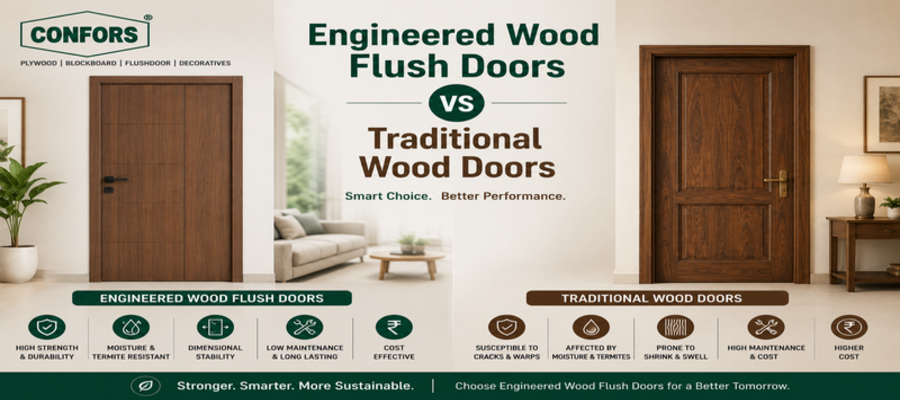
Engineered Wood Flush Doors vs Traditional Wood Doors: Which Door Stands Stronger—Style or Substance? Doors are not only utilitarian, but they present themselves as a face of your interiors and the very first impression of your home. Renovating or renewing, the type of door selected may not only influence appearance but also the durability, affordability, and future maintenance of space. And this leads us to the most common of the debates: Engineered Wood Flush Doors vs Traditional Wood Doors.
On the one hand, you have flush engineered wood doors, sleek, modern, and affordable. Alternatively, there is the traditional beauty of wooden doors – dense, timeless and robust. But which is the more cost-effective? Which fits your lifestyle and design aspirations? Today, we will decipher the main differences in materials, performance, appearance, price, and maintenance, so you can find the best option that will satisfy you at home or in any other project you intend to work on.
What is an Engineered Wood Flush Door?
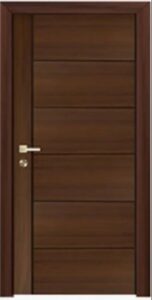
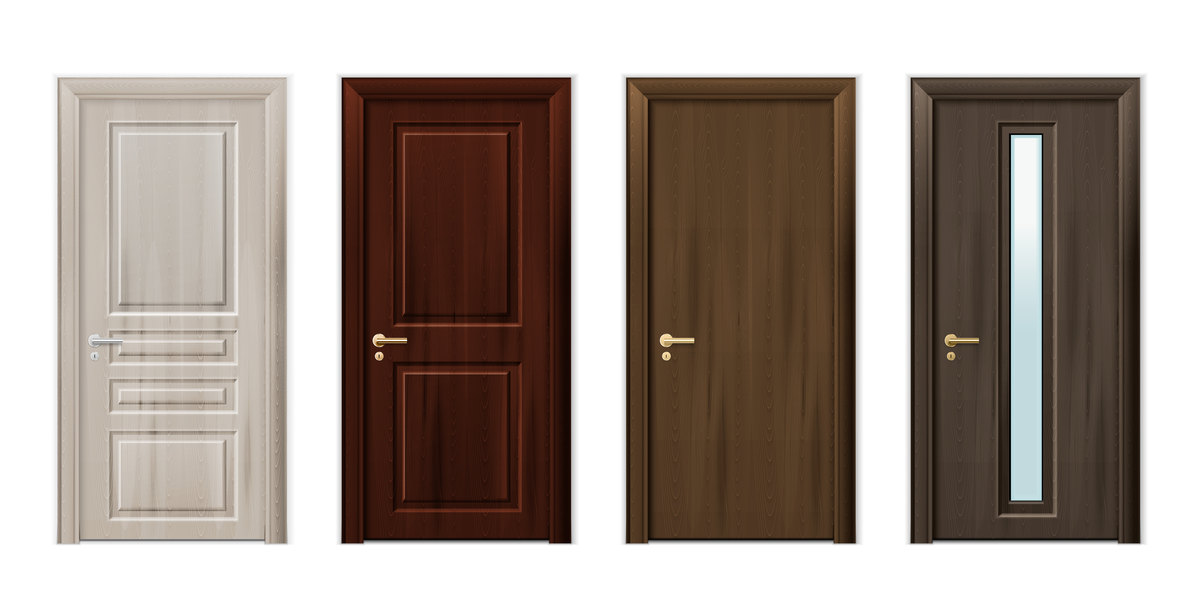
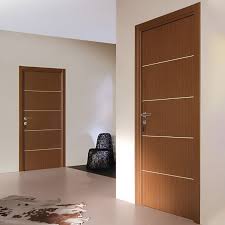
Engineered Wood and Flush Door is a modern style of door constructed with composite wood and has a flat and smooth surface. Such doors are solid-core (MDF (Medium-Density Fiberboard) or HDF (High-Density Fiberboard), blockboard, particleboard). On the outer surface, it is finished with a smooth, sleek finish in thin laminate, veneer or sheet hardwood.
The name of such doors is derived because there is no panelling on the surface or grooves. They are cheap and light in weight and perfect to use in interior doors of modern homes, offices and hotels and institutions. Conforsply, a trusted Plywood manufacturer in India, offers high-quality plywood-based flush doors designed to provide strength, durability, and modern aesthetics for residential and commercial spaces
Main Features:
- Flat smooth surface
- Very durable and lightweight
- Available in many designs and finishes
- Termite and moisture-proof (treated)
- Affordable and low-cost to maintain
What is a Traditional Wood Door?
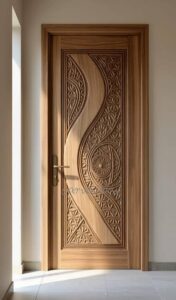
Traditional Wood Door contains solid natural hardwood such as teak, sheesham, Oak or Sal. Such doors are elaborate, heavy and thick and have a rich appearance and durability. The grain pattern on each of the doors is individual since they are cut from timber.
Conventional wooden doors are typically hand-crafted or machine-carved and may include panelling, arches, or artistry. These are great doors to use as main entrances or in a house that has a classic interior.
Main Features:
- Made from solid, natural hardwood
- Strong and long-lasting
- Premium and rich appearance
- Customizable with carvings and panelling
- Requires regular maintenance and polishing
Overview: Engineered Wood Flush Doors vs Traditional Wood Doors
| Feature | Engineered Wood Flush Doors | Traditional Wood Doors |
| Material | MDF, HDF, Blockboard with veneer/laminate | Solid natural wood (e.g., teak, sheesham) |
| Appearance | Flat, smooth, modern finishes | Natural wood grain, traditional or carved look |
| Weight | Lightweight | Heavy |
| Strength | Strong, but depends on core quality | Very strong and long-lasting |
| Weather Resistance | Stable in all weather (if treated) | May warp or swell without proper treatment |
| Maintenance | Low maintenance | Requires polishing and care |
| Price | Budget-friendly | Expensive |
| Use Case | Interior doors, offices, hotels | Main entrance doors, heritage homes |
| Eco-Friendliness | More eco-friendly (uses recycled wood) | Less eco-friendly unless sourced sustainably |
Detailed Differences Between Engineered Flush Doors and Traditional Wood Doors
Let’s explore the differences further so you can make a smart, informed decision:
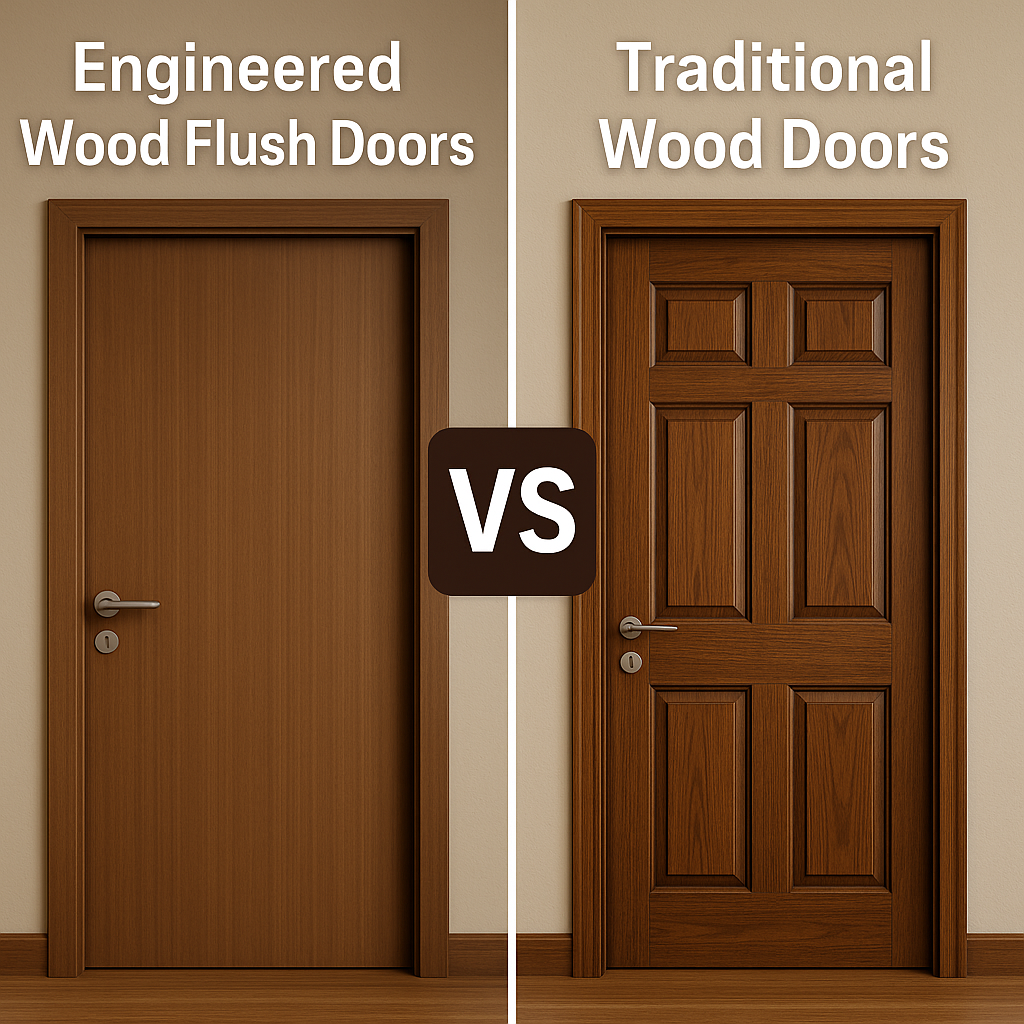
1. Material and Construction
- Processed wood materials are used in constructing Engineered Doors. They consist of a core (most likely blockboard or MDF) and top coat of laminate or veneer.
- Traditional Wood Doors are cut out in a block of hardwood. The inside of a door is solid.
Verdict: Engineered doors need less of a natural resource and offer greater design choices.
2. Design and Aesthetics
- Engineered Flush Doors have an even surface and can fit in modern and minimalistic designs. Several colours, patterns, and textures are available to your choice.
- Traditional Wood Doors are aesthetically beautiful with their grain. It is possible to include carvings, panels or decorations to make it look grand.
Verdict: If you are going to use modern look, use engineered doors, and if you want to give a classic/royal feel, use traditional doors.
3. Strength and Durability
- Engineered Doors are durable enough in normal usage. However, they are not strong, depending on the quality of the core material.
- Traditional Wood Doors are very strong and durable in nature and thus are well suited to be used in external doors.
Verdict: The traditional wood is longer-lasting, particularly when used as external.
4. Weather and Termite Resistance
- Engineered Doors can resist more moisture and climate changes as long as they are properly treated and laminated door.
- Traditional Wood Doors are subject to swellings and warping in moist sections. They must be treated with termite and moisture frequently.
Verdict: Engineered doors are more efficient in places where the weather is changeable.
5. Maintenance Requirements
- Engineered Doors require a minimal amount of maintenance. Just wipe it clean with a cloth.
- Traditional Wood Doors require being polished after several years and guarded against pests.
Verdict: Low maintenance is a win game by engineered doors.
6. Cost and Affordability
- Enginered Doors are also cheaper. This makes them suitable to be used in large numbers in apartments, offices, or hotels.
- Traditional Wood Doors are costly due to the full hardwood usage and the use of skilled labor.
Verdict: Engineered doors are best for budget-conscious projects.
7. Environmental Impact
- Engineered Doors have processed and recycled wood, thus sustainable.
- Shovel Shears Conventional Doors require the cutting of mature trees which is destructive unless used responsibly.
Verdict: Engineered doors are environmentally-friendly.
8. Where to Use Them
- Engineered Doors have processed and recycled wood, thus sustainable.
- Shovel Shears Conventional Doors require the cutting of mature trees which is destructive unless used responsibly.
Verdict: Engineered doors are environmentally-friendly.
Summary
If you’re looking for budget-friendly, low-maintenance, and modern-looking doors, then engineered wood flush doors are a great option for most interiors. However, if you prefer natural elegance, long life, and a premium finish, especially for your main door, then traditional wood doors are worth the investment.
In the debate of Engineered Wood Flush Doors vs Traditional Wood Doors, the final choice depends on where and how you plan to use them—balancing style, performance, and price. As an experienced Plywood Manufacturer In Yamunanagar, Conforsply manufactures premium plywood products and flush doors that meet the requirements of modern construction and interior design projects.
Smart Tip: Internal spaces should use engineered flush doors while entries may use solid wood doors to create balance among cost, style, and strength.
FAQs – Engineered Wood Flush Doors vs Traditional Wood Doors
Which is more affordable: engineered wood flush doors or traditional wood doors?
Engineered wood flush doors are more affordable compared to traditional solid wood doors.
Which door is more durable?
Both doors are durable, but traditional wood doors are generally stronger, while engineered flush doors provide good durability with less maintenance.
Are engineered wood flush doors moisture-resistant?
Yes, properly treated and laminated engineered flush doors can resist moisture and climate changes.
Which door requires less maintenance?
Engineered wood flush doors require less maintenance and can be easily cleaned compared to traditional wood doors.
Are engineered wood flush doors eco-friendly?
Yes, engineered wood flush doors use processed and recycled wood materials, which helps reduce the use of natural timber.